
In short
The body shop that repairs a fleet vehicle usually paints and blends the repaired panels, and either the shop or your sign vendor puts the lettering back. Fleet work goes well when you send the color formula or VIN, photos of both sides and the lettering artwork before painting, so the unit matches the rest of the fleet.
- A paint code is a starting point; fleet whites and faded units need tinting and blending.
- Custom company colors need the formula or a sample from you before painting.
- The EPA 6H rule sets training, booth and spray gun requirements for paint shops.
- Repainted panels that carried the USDOT marking must show it again on both sides.
- Check color, lettering and lights outdoors in daylight before you take the unit back.
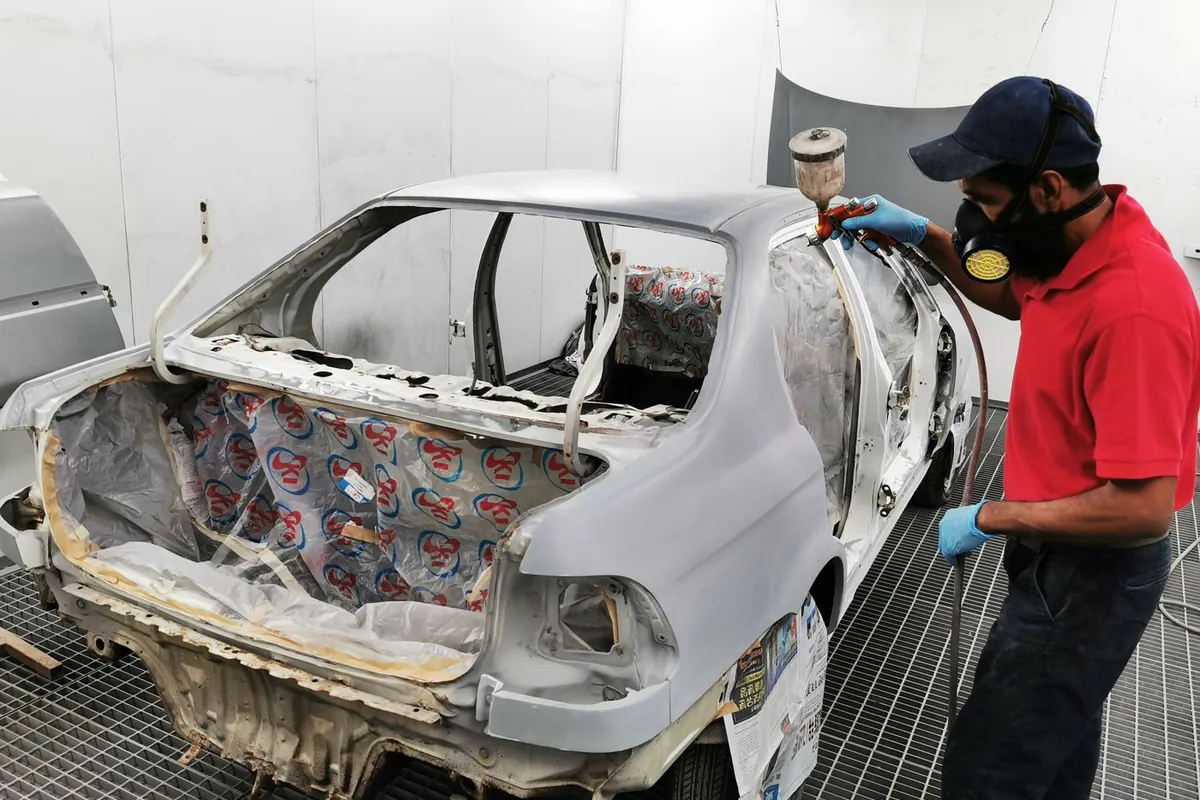
Who paints and letters fleet vehicles after body repair?
In most cases the body shop that repairs the damage also paints the repaired panels and blends the color into the panels next to them, and either the shop or your sign vendor puts the lettering back afterward. What makes fleet work different from a family car is the second half: your company color may not be a factory color, the units in your fleet may have faded differently, and the door that was replaced may have carried the company name, the USDOT number and the unit number. All of that has to come back matching the rest of the fleet.
So the useful answer is not just "a body shop". It is a body shop that will ask for your color and livery details before it paints, plan the lettering as part of the job, and hand back a unit that looks like the others parked beside it. For trucks and vans in and around Mesquite and Balch Springs, that is the work our fleet and work truck repair covers.
Why are fleet colors harder to match than ordinary paint?
Every factory color has a paint code, and a shop mixes from that code. But the code is a starting point, not a promise of a match, for a few reasons that matter more on fleets:
- Fleet whites are not all the same white. Different makers, model years and plants produce whites that look identical apart and different side by side.
- Custom fleet colors. Some companies order a color that is not on the maker's chart, or had units painted after purchase. The shop needs the formula or a sample.
- Sun and age. Units that park outside in North Texas fade at different rates. A fresh panel mixed to the code can look darker than a faded door next to it.
- Wraps and decals. Paint under a wrap or a large decal is often a different shade from the exposed paint around it.
That is why body shops usually blend new color into the next panel, so the eye does not land on a hard line between old and new paint. Our general guide on whether new paint will match the rest of the car explains blending in more detail, and peeling clear coat and faded paint covers sun-damaged finishes.
Not every mark on a fleet unit needs a full panel refinish. Scrapes from loading docks, gate posts and job-site brush are common on work vans and pickups, and some can be repaired in a smaller area. Whether a spot repair will hold up and blend on your color depends on how deep the damage goes and where on the panel it sits. Our guide on deep scratches: touch up or repaint the panel explains how that call is made, and the same reasoning applies to a fleet unit.
Which approach fits which fleet vehicle?
The table matches common fleet paint situations with the usual approach and what the shop needs from you.
| Situation | Usual approach | What to send the shop |
|---|---|---|
| Factory color, unit in good condition | Mix to the paint code, tint to the vehicle, blend into the next panel | VIN; the shop reads the code from the vehicle |
| Custom company color | Mix from your formula or match a sample | The formula or the name of the shop that first painted it, or an undamaged painted part |
| Older unit with faded paint | Tint to the faded paint; wider blend or refinish the whole side | Decide whether you want the side to match the unit or the fleet |
| Wrapped vehicle | Paint the repaired panel, then re-wrap that section | Wrap vendor contact and the print file |
| Rebrand or color change at repair time | Plan the full refinish with the lettering | New color, new artwork, and approval from whoever owns the brand |
Read the last column as your homework. A shop can usually match a factory color from the vehicle alone. Everything else depends on what you can supply, and the more you supply up front, the less chance the unit has to be redone.
What rules apply to a shop that sprays paint?
Auto refinishing is covered by a federal air rule, 40 CFR Part 63 Subpart HHHHHH, often called the EPA 6H rule. In plain terms, section 63.11173 says:
- Training. Painters who spray-apply coatings on motor vehicles must be trained and hold certification in spray application and in setting up and maintaining spray equipment. New painters have up to 180 days after hiring, and the training is valid for up to five years before refresher training is needed.
- Booths. Spray-applied coatings must go on in a spray booth, preparation station or mobile enclosure with filters shown to capture at least 98 percent of overspray. A booth used to refinish a complete vehicle must be fully enclosed, with a full roof and four walls or complete side curtains, and run at negative pressure.
- Spray equipment. Coatings must be applied with a high volume, low pressure (HVLP) gun, electrostatic application, an airless or air-assisted airless gun, or an equivalent technology approved in writing.
- Gun cleaning. Cleaning must not spray a mist of solvent and paint outside a container that collects the used solvent.
For a fleet, the practical step is to ask any shop you send work to, including us, how it meets these requirements. The rule sets the floor for how paint is sprayed; it does not by itself say anything about color match, which is a matter of skill and care.
How do the lettering and USDOT markings come back?
If a repainted or replaced panel carried your marking, it has to go back before the unit returns to work as a commercial motor vehicle. Under 49 CFR 390.21T, the marking shows the carrier's legal name or a single trade name and its number preceded by "USDOT", on both sides of the vehicle, in letters that contrast sharply with the background and are readily legible in daylight from 50 feet while the vehicle is stationary. It may be painted on or be a removable device.
Color work affects that rule in two ways. First, the new lettering has to match the other side, so send the exact text and artwork. Second, if the body color changes, check that the lettering color still contrasts sharply. Our guide on USDOT markings after body repair covers the choices between painted, vinyl and removable signs.
Ask the shop when vinyl can go on after the paint is finished, since that depends on the paint system, and decide in advance whether the shop, your sign vendor or your wrap company applies it. If a vendor is doing it, give the shop their contact so the handoff is planned, not improvised.
What else should come back the way it was?
Paint work means lamps, reflectors and tape often come off. Make sure they go back correctly.
- Lamps and reflectors. 49 CFR 393.11 ties the lighting on a commercial motor vehicle to its build date: units made on or after December 25, 1968 must meet, at a minimum, the FMVSS No. 108 lamp and reflector rules that applied when they left the factory.
- Conspicuity tape on trailers. The same section requires retroreflective sheeting, reflectors or both on trailers 80 inches or wider with a rating over 10,000 pounds built on or after December 1, 1993. Section 393.13 sets the pattern for older wide trailers, with sheeting at least 2 inches wide. A repainted trailer side or rear needs it back.
- Unit numbers, phone numbers and logos. Not federal items, but your customers and dispatch rely on them.
- Emblems and trim removed for paint.
What should you send, and what should you check at pickup?
Before the work starts, send:
- The VIN and, for custom colors, the formula or the name of whoever painted the fleet
- Photos of both sides of the unit, and of a sister unit if this one is badly damaged
- The exact lettering text and artwork files, or your sign or wrap vendor's contact
- Your choice: match this unit, or match the fleet
- Who approves the color and the lettering proof
At pickup, look at the unit outside in daylight, from a few steps back and from an angle. Check the color from both ends, compare both sides' lettering, step back to see if the name and number read clearly, and confirm every light works. Small edge marks or masking lines are easier to fix before the unit leaves than after. If you want a broader view of fleet collision work near you, see fleet collision repair near Mesquite and Balch Springs and how fleet accounts work.
How ACE Body & Frame helps
ACE Body & Frame has been on S. Peachtree Road in Balch Springs since 1987, serving Balch Springs, Mesquite and the surrounding area. We do collision repair, auto body and paint, suspension and frame repair, welding, fabrication, fiberglass repair and fleet and work vehicle repair with fleet discounts. Past fleet jobs include transit buses, utility-bed trucks and large fleets.
Tell us at the estimate whether the unit carries a custom color, a wrap or lettering, and send the details above; we will plan the paint and the markings together. We accept all insurance claims, estimates are free and computerized, and repairs are satisfaction guaranteed. See finished jobs on our work page, and more fleet answers under fleet and work trucks.
Call 972-286-0935 Monday to Friday, or request a free estimate with photos of both sides of the unit. For several units in one color, send us your fleet details and the color formula once.
Questions people ask next
Why does a new panel look different from the rest of our white van?
Whites vary by maker, model year and plant, and older units fade in the sun. A panel mixed to the paint code alone can look brighter or darker next to faded paint. Shops tint the mix to the vehicle and blend into the next panel. Decide whether you want it to match the unit or the fleet.
Can the shop match a custom company color?
Usually, if you supply the information. Send the color formula, the name of whoever first painted the fleet, or an undamaged painted part the shop can match. Without any of those, the shop has to match by eye from the vehicle, which takes longer and is harder to repeat across several units.
Who puts the lettering back on after the repaint?
Either the body shop or your sign or wrap vendor, depending on how your fleet is set up. Decide before painting and give the shop the vendor's contact, the exact text and the artwork. Ask when vinyl can go on after the paint is finished, since that depends on the paint system used.
What does the EPA rule require of auto paint shops?
Under 40 CFR 63.11173, painters who spray-apply coatings must be trained in spray application and equipment setup, spraying must happen in a booth or enclosure with filters capturing at least 98 percent of overspray, and approved gun types such as HVLP must be used. Ask any shop how it meets the rule.
Does a color change affect our USDOT marking?
It can. Under 49 CFR 390.21T the marking must contrast sharply with the background and be readily legible in daylight from 50 feet. If the body color changes, check that the lettering color still stands out clearly, and that both sides show the same name and number after the work.
Ready to get your vehicle back to work?
ACE Body & Frame, 2922 S. Peachtree Road, Balch Springs. Free computerized estimates, all insurance claims accepted.
Sources
Read next
 Fleet and work trucks
What does a commercial vehicle need after a crash before it goes back in service in Texas?
Before a repaired work vehicle runs again in Texas: safety repairs done, driver defects signed off, inspection proof on board, markings back, records filed.
 Fleet and work trucks
Who repairs box trucks after a collision in Dallas County?
A box truck needs a shop that fixes the cab, the frame and the box. How to sort the damage, what federal rules ask after a crash, and what to send us.
 Fleet and work trucks
Where can I get a Ford Transit cargo van body repaired near Dallas?
A Transit needs a shop that fits a tall van, scans it before and after as Ford requires, and handles sensors, shelving and lettering. What to ask and bring.
More: all fleet and work trucks guides, fleet & work trucks, repair by make, reviews and directions to the shop.