
In short
Yes, in most repairs new paint can match so well that you cannot find the repair by color. The match comes from testing the mixed color against your car and blending it into the neighboring panel, not from the paint code alone. Pearl whites, bright reds, silvers and sun-faded paint are the hardest, so ask which panels will be blended.
- A paint code names a formula, not the color your car is today.
- Blending into the next panel is what hides the repair.
- Pearls, reds, silvers and faded paint need the most care.
- A bumper cover can differ slightly from the fender even from the factory.
- Check the finished repair outdoors, in sun and in shade, before you leave.
Will the new paint match the rest of my car?
In most repairs, yes, to the point where you cannot find the repair by looking at the color. That result does not come from the paint code alone. It comes from three things done together: mixing the right version of your color, testing it against your car before it is sprayed, and fading the new color into the panel next to the repair so there is no hard line for your eye to catch.
A match is hardest on pearl whites, three-stage reds, silvers and other light metallics, and on cars whose paint has spent years in the Texas sun. On those, the plan for the match matters more than the brand of paint. A written estimate should tell you which panels will be painted in full and which will be blended. If it does not, ask before you sign.
Why does the same paint code look different on two cars?
The paint code on the sticker in your door jamb or under the hood names a color formula. It does not describe the paint on your car today. Three things pull the two apart.
- Factory variation. The same color is sprayed at more than one plant, over more than one model year, with more than one batch of paint. Paint makers publish several versions of a single code for that reason, often called variants. One may lean slightly yellow, another slightly blue, another coarser in the metallic.
- Age and sun. Paint that has sat outside in North Texas summers changes. Reds and some blues lose depth, whites warm up, clear coat dulls. A fresh mix of the original formula can look too bright next to it.
- Earlier repairs. If a panel was painted once before, it may already be a variant of the factory color. Matching the car now means matching that panel too.
So a careful painter picks the closest variant, sprays a test card, and holds it against the car in daylight and in shade. If it is off, the formula is adjusted and tested again before paint goes on the vehicle.
What is blending, and why paint a panel that was not hit?
Blending means spraying the new color across the repaired panel and then letting it thin out gradually across part of the neighboring panel, with clear coat over the whole area. The color does not stop at a door gap. It fades away where your eye cannot find an edge.
People are often surprised to see an undamaged door or fender on the estimate. Two panels painted a tiny shade apart look wrong side by side, especially at a body line. Blending removes that comparison. It is a standard part of refinishing, not an add-on.
Blending is not always needed. A panel with natural breaks all around it, such as a bumper cover or a mirror cap in a solid color, can sometimes be painted alone. A door in the middle of a silver car almost never can. If your repair involves more than paint, our guide to how long body and paint repair takes explains where refinishing sits in the schedule.
Which colors are hardest to match?
The table below shows the common color types, why each one is easy or hard, and what to ask a shop about it.
| Color type | Why it is easy or hard | What to ask the shop |
|---|---|---|
| Solid white, black or a plain solid color | No metallic flake to line up. Fade and yellowing are the main risks on older cars. | Will the panel be painted alone or blended into the next one? |
| Silver, gray and light metallics | The flakes lie down differently depending on how the paint is sprayed, so the color shifts as you walk past the car. | Which panels are being blended, and will you check a test card from more than one angle? |
| Pearl white and other three-stage colors | A base color, a translucent pearl layer and a clear coat. The thickness of the pearl layer changes the final shade. | How do you test the pearl layer before you spray my car? |
| Bright and candy reds | Often layered and translucent, and reds fade in the sun faster than most colors. | How will you handle the difference between fresh red and my faded red? |
| Matte or satin factory finishes | The sheen cannot be polished to adjust it afterward. | Have you refinished this finish before, and does the maker allow spot repairs on it? |
| Older single-stage or custom paint | No current factory formula, or a formula that never existed. | Will you mix to the car by eye and test cards, and is a full repaint the better route? |
Read it by finding your color in the left column. The further down the table your color sits, the more you should expect blending on the estimate, and the more a quote that paints only the damaged panel deserves a second look.
Why can a bumper look a shade off from the fender beside it?
Walk through any parking lot and you will see new cars whose bumper covers are a touch different from the metal next to them. Bumper covers are plastic. They are often painted separately from the steel or aluminum body, with a flexible additive, and the color sits differently on plastic than on metal. The angle of the part also changes how metallic flake reflects.
So a small difference between bumper and fender can be how the car left the factory. Compare the other end of the car. If your repair involves the cover itself, see our guide on whether to repair or replace a bumper cover, which also covers the sensors mounted behind it.
Texture matters as much as color. Factory paint has a fine ripple called orange peel. A repaired panel polished glass-smooth next to a factory panel with ripple will look different even if the color is perfect. A good refinish aims to copy the factory texture, not beat it.
Will the insurance company pay for blending and for the parts I choose?
On a claim, the paint work is part of the repair estimate. The Texas Department of Insurance (TDI) describes the process this way: the insurer provides a repair estimate, and if repairs cost more, the shop sends a new estimate to the insurer, which pays the extra amount if it agrees. Blending that was left off the first estimate is handled the same way. We explain that step in our guide to supplements on a repair estimate.
Two more points from Texas rules help here:
- You choose the shop. The Texas Consumer Bill of Rights for personal auto insurance says you have the right to choose the repair shop and parts for your vehicle. It also says the company is not required to pay more than a reasonable amount.
- Your deductible still applies on your own policy. TDI says the company subtracts your deductible from the payment and you pay that amount to the shop.
The claim is yours. A shop documents why a blend is needed and sends it to the adjuster, but the insurer decides what it will pay, and you decide whether to accept that. If the two estimates are far apart, read what to do when the insurance estimate is lower than the shop estimate.
What rules does a shop have to follow when it sprays paint?
Color is judgment. Spraying is regulated. A federal air rule, 40 CFR 63.11173, sets standards for shops that spray-apply coatings on motor vehicles. In plain terms it requires that:
- Painters are trained. People who spray coatings must have completed training in spray application and in setting up and maintaining spray equipment. The training has to be in place no later than 180 days after hiring and is valid for up to five years before a refresher is required.
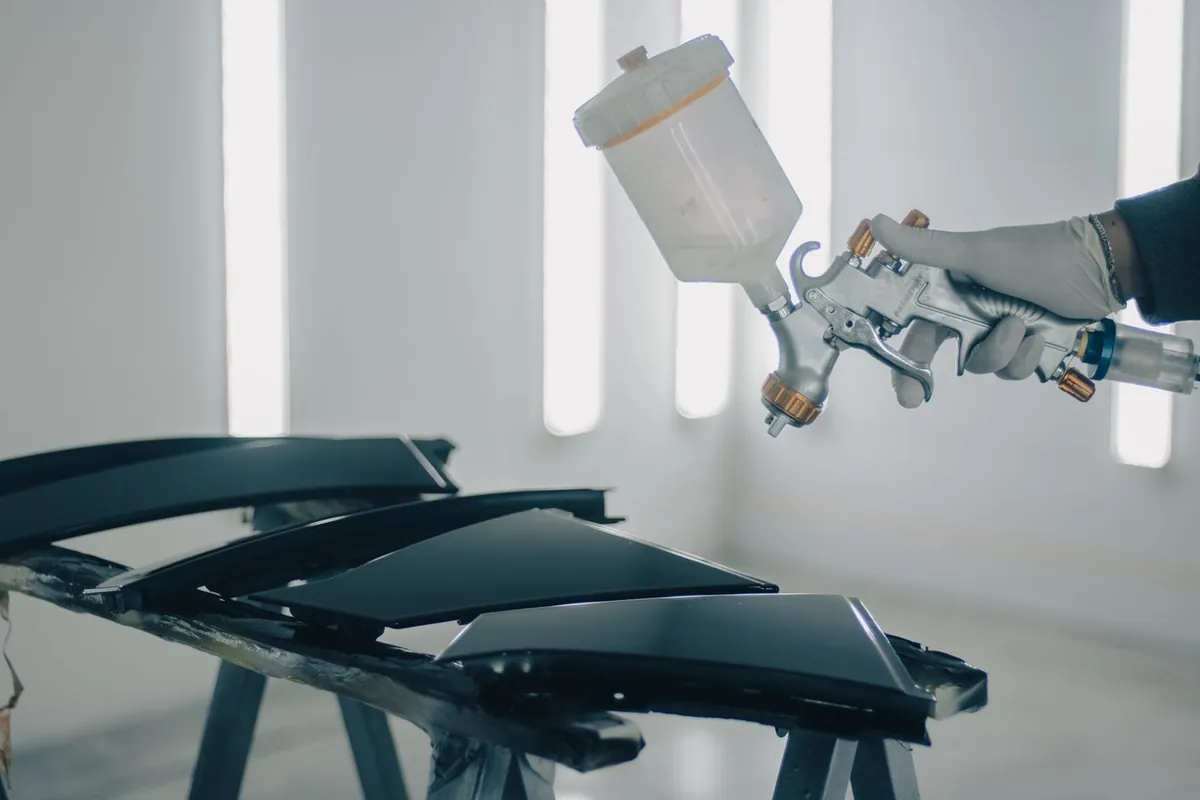
- Paint is sprayed in an enclosure with filters. Coatings must be applied in a spray booth, preparation station or mobile enclosure fitted with filters shown to capture at least 98 percent of paint overspray. A booth used to refinish complete vehicles must be fully enclosed, with a full roof and four complete walls or side curtains.
- Approved spray guns are used. The rule lists high volume, low pressure (HVLP) guns, electrostatic application, airless or air-assisted airless guns, or an equivalent approved in writing.
A clean, enclosed, filtered space keeps dust out of wet paint, and a trained painter lays metallic flake down evenly. Ask any shop, including us, where your vehicle will be sprayed and who will spray it.
How do I check the match when I pick up the car?
You do not need a trained eye. You need daylight and a little patience.
- Look outside, not under shop lights. Ask for the car to be pulled into the open. Check it in direct sun and again in shade.
- Stand back first. From a few car lengths away, look down the whole side. A mismatch shows as a panel that looks like it belongs to a different car.
- Walk past it. With metallics and pearls, watch the repaired area as your angle changes. The color should shift the same way on every panel.
- Check the edges. Open the door, hood or trunk. Look for a tape line, dry or rough spray on the edges, and paint on rubber seals or trim.
- Compare the texture. Look at the reflection of a straight object, such as a light pole, across the old and new panels.
- Look for dust and runs. Small specks, sags or dull patches in the clear coat should be pointed out before you leave.
If something looks off, say so on the spot.
How ACE Body & Frame helps
ACE Body & Frame has been on S. Peachtree Road in Balch Springs since 1987. Auto body and paint is a core part of what we do, alongside collision repair, frame work, glass and mechanical service, for drivers in Balch Springs, Mesquite and the surrounding area.
- We write a free computerized estimate that lists which panels are repaired, which are painted and which are blended. You can request a free estimate and tell us your color and model year.
- We accept all insurance claims. We document the damage and the refinish work, and we work with the adjuster. You have the right to choose where your vehicle is repaired.
- Repairs are satisfaction guaranteed. If the color does not look right to you when you pick the car up, tell us.
What to bring: the vehicle, the insurer's estimate if you have one, and any history you know about earlier paint work. Wash the car first if you can, because a clean panel shows its true color.
Related reading: touch up or repaint for a deep scratch, options for peeling clear coat and faded paint, and the rest of our paint, dent and hail guides. You can also see finished repairs in our work gallery or learn what our body and paint repair service covers.
Questions about a specific color? Call 972-286-0935, Monday to Friday, or send us photos for a paint estimate. We are at 2922 S. Peachtree Road, Balch Springs, Texas 75180.
Questions people ask next
Why is the shop painting a panel that was not damaged?
That is blending. The new color is faded across part of the neighboring panel and cleared over, so there is no sharp line where new paint meets old. Two panels a tiny shade apart look wrong side by side. Blending removes that comparison, and it is the main reason a careful repair cannot be seen afterward.
Can you match paint from the paint code alone?
The code is the starting point. Paint makers publish several versions of one code because factory color varies by plant, year and batch, and your car has also aged in the sun. A careful painter sprays a test card, compares it with your car in daylight and adjusts the mix before painting the vehicle.
Will my insurance pay for blending the next panel?
Blending is part of the repair estimate. The Texas Department of Insurance explains that if repairs cost more than the insurer's estimate, the shop sends a new estimate and the insurer pays the extra amount if it agrees. The shop documents why the blend is needed. The claim and the final decision stay with you.
My bumper looks a slightly different shade than the fender. Is that a bad repair?
Not always. Bumper covers are plastic, are often painted apart from the metal body, and reflect light at a different angle, so many cars show a small difference from new. Compare the other end of the car or the same model in the same color. If the repaired end looks clearly worse, tell the shop.
How soon can I wash or wax the car after it is painted?
Fresh paint keeps hardening for a while after you get the car back. How long depends on the paint system used, so there is no single answer that fits every repair. Ask the shop that painted it when gentle hand washing is fine and when it is safe to wax or polish, and follow that advice.
Ready to get it fixed?
ACE Body & Frame, 2922 S. Peachtree Road, Balch Springs. Free computerized estimates, all insurance claims accepted.
Sources
- 40 CFR 63.11173
- TDI, "Were you in a wreck? Tips for auto insurance claims"
- Consumer Bill of Rights, Personal Automobile Insurance (28 TAC 5.9970(b), 2026 Version)
- TDI, "Steps to getting your home or car insurance claim paid"
Read next
 Paint, dents and hail
Dent or door ding near Balch Springs: can it be fixed without repainting?
Many dents with unbroken paint can be pushed out with no repainting. See which dents need paint, what the repair involves and when to use insurance.
 Paint, dents and hail
Windshield or door glass broken in a wreck near Mesquite: who replaces it?
After a wreck, glass is best replaced with the body repair so the opening is straight and cameras are calibrated. What to ask about glass and drive-away.
 Paint, dents and hail
Deep scratch or keyed car in Mesquite: touch up or repaint the panel?
A scratch in the clear coat can be polished; one through the color needs the panel refinished. How to check depth and when a keyed car is a claim.
More: all paint, dents and hail guides, collision repair, repair by make, reviews and directions to the shop.