
In short
A unibody vehicle has no separate frame, so structural damage is repaired in the welded and bonded shell itself. A body-on-frame vehicle has a separate ladder frame with the body bolted on, so the frame can be straightened or partly replaced on its own and body parts swapped as units. Both repair well when the maker's procedure is followed.
- Most cars, minivans and crossovers are unibody; most full-size pickups are body-on-frame.
- On a unibody, damage can travel through the shell far from the dent.
- On a truck, a bent frame can hide under straight panels.
- Makers differ on sectioning, heat and aluminum, even between similar trucks.
- Ask for the measurement report whichever design you drive.
What is the difference between unibody and body-on-frame when my vehicle is repaired?
A unibody vehicle has no separate frame: the floor, rails, pillars and roof are welded and bonded into one shell, so structural damage is repaired in the body itself. A body-on-frame vehicle has a separate ladder frame with the cab, bed or body bolted on top, so the frame can be measured, straightened or partly replaced on its own, and the body pieces can often be unbolted and replaced as units. Most cars, minivans and crossovers are unibody. Most full-size pickups and some large SUVs are body-on-frame.
For you as the owner, the design changes how a shop finds the damage, what can be straightened or replaced, which maker rules apply, and how big the job is. Both kinds can be repaired well. They are just repaired differently.
How can I tell which one my vehicle is?
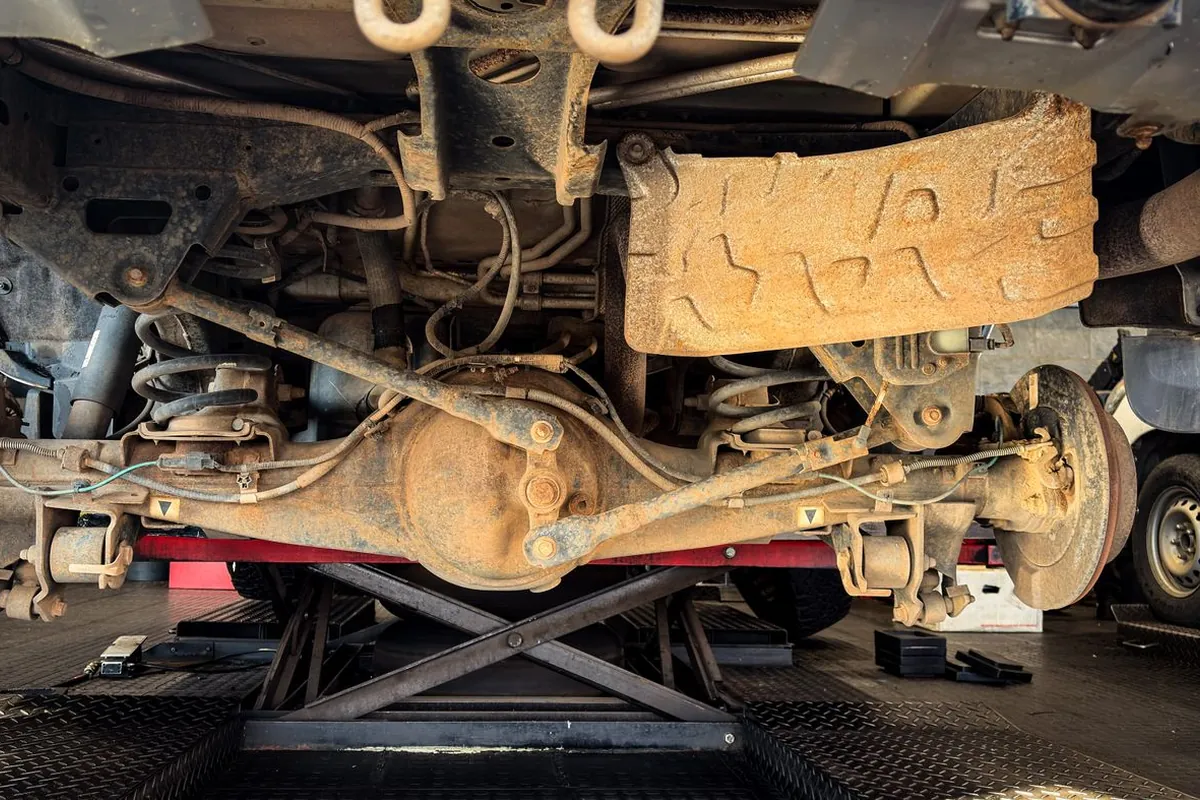
A quick way is to look underneath, behind a front wheel. On a body-on-frame truck you will see a heavy rail running front to back, with the body sitting on mounts above it, often with a visible gap. On a unibody vehicle the rails are part of the floor pan and blend into the body. A few general patterns help:
- Usually unibody: sedans, hatchbacks, coupes, minivans, most crossovers and many mid-size SUVs, plus most electric cars.
- Usually body-on-frame: full-size and many mid-size pickups, heavy-duty trucks, and some large, truck-based SUVs.
Model lines change over the years, so if you are not sure, give the shop your VIN and it can look up the structure for your exact vehicle.
How do the two designs handle a crash?
Both are designed to absorb crash energy before it reaches the cabin, but they do it in different places.
- Unibody. The whole shell shares the load. Front and rear rails are built to fold in a controlled way, and the pillars, rockers and roof rails form a safety cell around the occupants. Energy can travel through the shell, so a hit on one corner can shift points far from the dent.
- Body-on-frame. The frame takes most of the load, and the body rides on mounts. A hit through the bumper or hitch goes into the frame rails. The cab and bed can stay straight while the frame bends, or the reverse.
I-CAR, the collision industry's training organization, notes that today's structural parts are made from high-strength steel, ultra-high-strength steel, aluminum and carbon fiber, and many are designed to collapse or transfer forces in a specific way. That is true of both designs, and it is why the maker's repair information drives every structural repair.
How does the repair differ in practice?
The table compares the two designs at each stage of a structural repair.
| Stage | Unibody | Body-on-frame |
|---|---|---|
| Finding the damage | Measure the whole shell; damage can be far from the impact | Measure the frame; check the body mounts and the cab and bed separately |
| Straightening | Vehicle anchored and pulled as one unit | Frame straightened, sometimes with the cab or bed lifted off |
| Replacing parts | Welded or bonded panels replaced at factory seams or published sectioning points | Bolt-on cab, bed and bumper parts swapped; frame sections replaced only where the maker publishes a procedure |
| Joining methods | Spot welds, adhesives, rivets as the maker specifies | Frame welds and bolted parts as the maker specifies |
| Main risk if done badly | Safety cell and crumple zones no longer behave as designed | Frame misaligned under a body that looks fine |
| Typical next steps | Alignment, scans and sensor calibrations | Alignment, scans, and checks of hitch and towing hardware |
Read across each row rather than down. Neither column is "easier"; each has its own trap. On a unibody, the trap is damage that traveled through the shell. On a body-on-frame truck, it is a bent frame hidden under straight panels.
What do makers say about straightening, heat and sectioning?
This is where the vehicle you drive matters more than its design. Each maker publishes its own rules, and they differ even between similar vehicles.
Body-on-frame trucks. According to I-CAR, GM released a sectioning kit for the front frame rails of 2011 and later Silverado and Sierra heavy-duty pickups, with both front rail service sections, the front crossmember and instructions. For the 2017 Ram 1500, I-CAR reports partial replacement of the front lower rails at factory seams, one sectioning location on the upper rail, and no replacement procedures for the rear rails. Toyota, according to I-CAR, does not approve frame sectioning on its full-frame vehicles. Three trucks, three different answers.
Unibody vehicles. Ford says that where no specific Ford procedure exists, structural repairs should be made at original factory joints or seams. Stellantis says structural distortion must be corrected with straightening equipment and a three-dimensional measuring system, and that structural panels must be installed whole unless a partial replacement procedure is documented. Tesla, according to I-CAR, does not allow pulling or pushing body structure parts with frame straightening equipment and requires structural repairs on an approved frame bench unless the procedure states otherwise.
Heat, on both. Many steels lose strength when heated. According to I-CAR's summary of GM's steel matrix, heat is not recommended on ultra-high-strength and dual phase steels, while controlled heat on mild and high-strength low alloy steel is allowed only within set limits. Other makers have their own tables. The practical rule for owners: ask what the maker allows on the parts in your repair.
Does aluminum change the picture?
Yes, for both designs. Some body-on-frame trucks use aluminum cabs and beds on a steel frame, and some unibody vehicles use aluminum panels or structure. Aluminum dents, straightens and joins differently from steel, so its repair follows the maker's own aluminum procedure. According to I-CAR, Ford requires a dedicated aluminum welder for the F-150, specifically a 220-volt unit with Pulse MIG technology. Our Ford F-150 repair guide covers that truck, and the hybrid and EV repair guide covers electric unibody vehicles, which add battery precautions.
Ask any shop, including us, how it will handle aluminum on your specific vehicle before you agree to the repair.
Does the design change the estimate, the timing or a total loss?
It can change all three, though never in a fixed way. Here is what tends to drive each one.
- The first estimate. On a unibody vehicle, the full extent of structural damage often shows only after the damaged area is taken apart and measured, so added findings are common. On a truck, the bed or cab may need to come off before the frame can be fully checked. In both cases, extra damage found later goes to the insurer as a supplement.
- Parts and timing. Bolt-on truck parts such as a bed, bumper or tailgate can be quick to swap when they are in stock. Large welded unibody panels and frame sections may have to be ordered and take longer to fit, finish and measure.
- A total loss. The Texas Department of Insurance says insurers compare the repair cost with the vehicle's value, whatever its design. Heavy structural damage on an older vehicle is more likely to tip that balance. Our guide on whether insurance will total a bent frame explains how that decision is made in Texas.
Ask the shop at the start which parts of your repair are most likely to grow once the vehicle is apart, so the news does not come as a surprise.
What should I ask, whichever kind I drive?
- Is my vehicle unibody or body-on-frame, and where did the energy go?
- Will you measure the structure, and may I see the report?
- Which structural parts will be straightened, and which replaced?
- Does my maker publish sectioning points for this area, or must the part be replaced whole?
- Are any of the parts aluminum or ultra-high-strength steel, and what does the maker allow on them?
- On a truck: will the cab or bed come off, and will the hitch and body mounts be checked?
- What happens after the structure: alignment, scans, calibrations?
Bring the claim details, your registration for the VIN, photos from the scene and a list of anything that changed since the crash. If you are still deciding whether there is structural damage, start with signs of frame damage. If there is, read whether frame damage is fixable and safe. Truck owners should also see whether a bent truck frame can be repaired and the Tacoma and Tundra frame guide. Questions for a frame shop are in frame straightening near Mesquite, and more is on our frame and suspension topic page.
How ACE Body & Frame helps
ACE Body & Frame has done frame and suspension repair on S. Peachtree Road in Balch Springs since 1987, serving Balch Springs, Mesquite and the surrounding area. We repair both designs: unibody cars, minivans and crossovers, and body-on-frame pickups, work trucks and fleet vehicles. Collision repair, body and paint, welding and fabrication, and foreign and domestic diagnostics are also on our service list.
We write free computerized estimates and accept all insurance claims. At the estimate we will tell you which design your vehicle uses, what we find, and how your maker's procedure shapes the repair. The claim remains in your name: our part is to document the damage, write the estimate and work with your adjuster. Where the vehicle is fixed is your decision, because you have the right to choose where your vehicle is repaired. If the vehicle should not be driven, towing is available, a rental car can be arranged, and repairs are satisfaction guaranteed.
Call 972-286-0935, Monday to Friday, or request a free frame estimate online. You can see vehicles we have repaired and more on our structural and suspension repair page, or send photos of the damage and your VIN for a first look.
Questions people ask next
Is body-on-frame stronger or safer than unibody?
Neither is simply safer. Each is engineered to manage crash energy in its own way, and both are built with high-strength materials today. What matters after a wreck is that the repair restores the structure the maker designed, using its procedures, measurements and supported parts. A poor repair weakens either design.
Is a unibody repair more expensive than a frame repair on a truck?
It depends on the damage, the parts and the maker's procedure, not on the design alone. A truck can often have a bumper, bed or cab part swapped as a unit, while a unibody repair may mean cutting out welded panels. But a truck frame with no published sectioning procedure may need larger parts replaced. The estimate shows the real picture.
Can a unibody car be put on a frame machine?
Yes, most can. The vehicle is anchored at set points and pulled back toward its original dimensions while it is measured. Some makers set limits: Tesla, according to I-CAR, does not allow pulling or pushing of body structure parts with frame straightening equipment. Ask what your maker allows before work begins.
Why does my truck's body look fine when the frame is bent?
Because the body sits on mounts above the frame. A hit through the bumper or hitch goes straight into the frame rails, and the cab and bed can ride along without creasing. Signs include an uneven gap between cab and bed, a crooked hitch, a pull, or uneven tire wear. Measuring the frame settles it.
Do unibody and body-on-frame vehicles both need an alignment after structural repair?
Usually, yes. Structural work moves the points the suspension mounts to, so the wheels are checked and aligned once the structure is right. On vehicles with driver assistance cameras or radar, calibrations often follow the alignment. Ask for the alignment printout and any calibration records with your invoice.
Ready to get it fixed?
ACE Body & Frame, 2922 S. Peachtree Road, Balch Springs. Free computerized estimates, all insurance claims accepted.
Sources
- I-CAR RTS, "Structural Sectioning Procedures: Toyota/Lexus"
- I-CAR RTS, "GM Has New Front Full-Frame Sectioning (Heavy Duty) Part Kit Available"
- I-CAR RTS, "Sectioning And Partial Part Replacement: 2017 RAM 1500"
- Ford Collision Position Statement, "Structural Repairs" (October 1, 2025)
- FCA US LLC Position Statement, "Structural Repair Parts Usage" (December 1, 2025)
- I-CAR RTS, "Structural Straightening On Tesla Vehicles: UPDATE"
- I-CAR RTS, "Straightening And Heat: General Motors"
- I-CAR RTS, "Becoming Ford F-150 Recognized Aluminum Repairer"
- I-CAR RTS, "The Effects Of Wheel Alignment On ADAS"
- TDI, "My car was totaled! Now what?"
Read next
 Frame and suspension
How do I know if my car has frame damage after an accident?
Uneven gaps, sticking doors, a pull or a crooked wheel can mean frame damage. See the signs you can check yourself and why only measuring settles it.
 Frame and suspension
Suspension damage after hitting a pothole or curb in Dallas: what breaks?
A pothole or curb hit damages the tire and wheel first, then the steering and suspension links. See the warning signs, what makers say and what to do next.
 Frame and suspension
How much does frame damage change what my car is worth in Texas?
Frame damage usually lowers resale value, most of all with a rebuilt salvage title. See what Texas law says, what buyers ask and which records protect you.
More: all frame and suspension guides, frame & suspension, repair by make, reviews and directions to the shop.