
In short
Watch for uneven gaps around the hood, doors and trunk, doors that stick, a car that pulls or sits low at one corner, an off-center steering wheel, uneven tire wear and kinked metal underneath. Several signs on one corner usually mean the structure moved. Only measuring against the maker's dimensions confirms frame damage.
- Compare gaps, doors and stance left to right in daylight.
- Several signs on one corner usually mean structural damage.
- A bumper can spring back while the rail behind it is bent.
- Only measurement against the maker's dimensions settles it.
- Missed frame damage can strain tires, brakes and the drivetrain.
How can I tell if my car has frame damage after an accident?
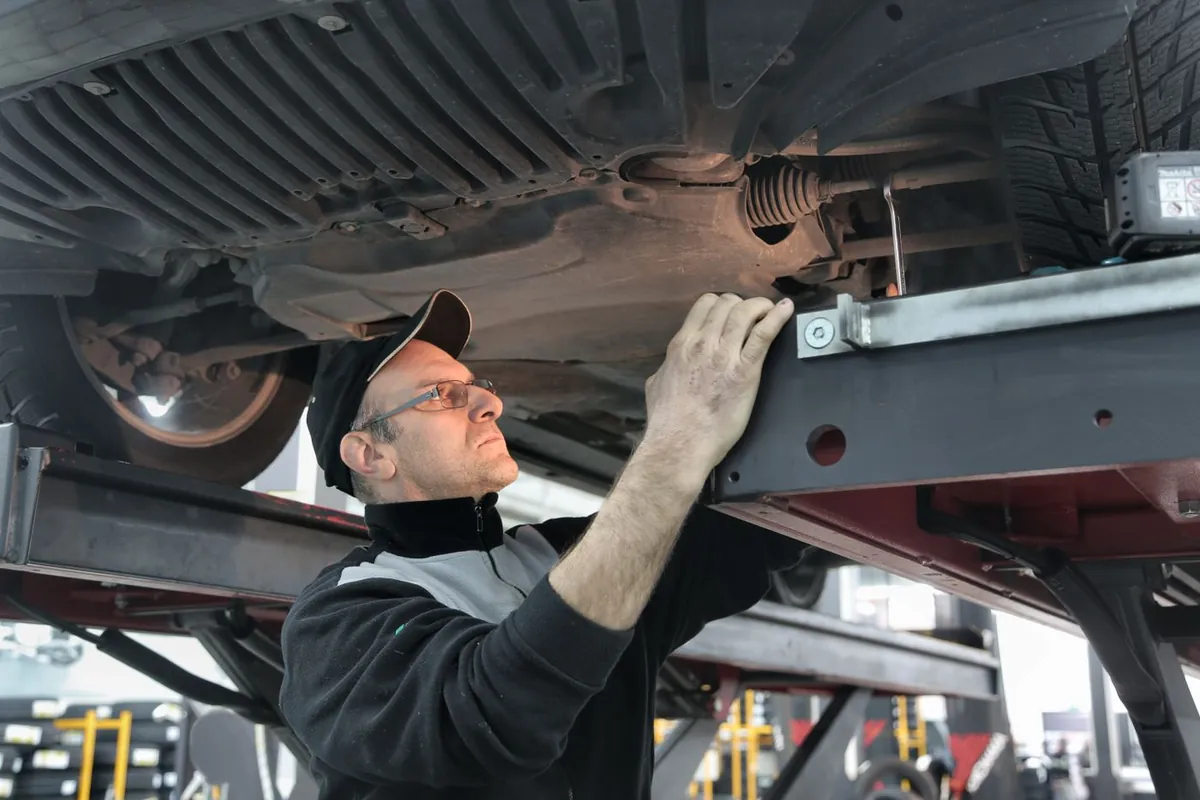
You often cannot be sure by looking, but there are clear warning signs. Uneven gaps around the hood, doors or trunk, doors that are hard to close, a car that pulls or sits lower at one corner, a steering wheel that is off center, tires wearing unevenly, and wrinkled metal under the car or inside the trunk all point toward structural damage. If you see two or more of these after a hit, assume the structure is involved until a shop has measured it.
Measurement is the only real answer. A body shop compares points on the underbody and in the engine and trunk areas with the maker's published dimensions. If the points are where they should be, the structure is straight. If not, the measurements show how far and in which direction it moved.
What counts as the "frame" on a modern car?
Most cars and crossovers today have no separate frame. They are built as a unibody, where the floor, rails, pillars and roof form one welded and bonded shell. Most full-size pickups and some large SUVs are body-on-frame, with the body bolted to a separate ladder frame. When people say "frame damage" they mean damage to whichever of these carries the load and the crash energy.
Ford's definition of a structural repair is a useful one to keep in mind. It includes any part that carries crash energy or vehicle loads (frame rails, reinforcements), forms part of the occupant safety cell (pillars, roof rails, rockers), provides attachment for safety systems (seat belt and air bag mounts), or is welded, bonded or riveted at the factory to other structural parts. Damage to any of those is structural damage, whether or not the word "frame" fits. Our guide comparing unibody and body-on-frame repair explains the two designs.
What signs can I check myself?
Walk around the car in daylight on level ground. Compare left with right, since the undamaged side is your best reference.
- Panel gaps. Look at the gap between the hood and each fender, around each door and around the trunk lid or liftgate. A gap that is wide at one end and tight at the other is a classic sign.
- Doors, hood and trunk. Open and close each one. Sticking, rubbing, a latch that needs a slam, or a door that drops when opened can mean the opening has changed shape.
- Stance. From a few steps back, check whether one corner sits higher or lower than the others.
- Steering and pull. On a straight, flat road, note whether the steering wheel is centered and whether the car drifts to one side.
- Tires. Look for new uneven wear, a tire that is tilted, or a wheel that sits further forward or back in its opening than the one on the other side.
- Under the car and in the trunk. With a flashlight, look for kinks, ripples or cracked seam sealer on the rails, the floor of the trunk and the spare tire well.
- Noises and leaks. New creaks, wind noise or water inside after rain can mean a seal no longer meets its opening.
None of these alone proves frame damage. A door can sag from a bent hinge, and a pull can come from a bent tie rod. But they tell you where to point the shop.
Check inside the car too. A windshield that cracked from a corner without being struck, a sunroof or door glass that no longer seals, a dashboard or headliner that has shifted, and seat belts that are slow to retract can all follow a structure that flexed. On a pickup or large SUV with a separate frame, look along the frame rails from behind the front wheels and in front of the rear wheels for bends, and at the gap between the cab and the bed, which should be even from top to bottom. Note what you find before the car goes to the shop, so nothing is overlooked at the estimate.
What do the signs usually mean?
The table pairs common signs with what they often indicate and what to do next.
| Sign | What it may mean | What to do |
|---|---|---|
| Hood gap wider on one side | Front rail or apron pushed back or sideways | Have the front structure measured before parts are ordered. |
| Door hard to open or close | Pillar or door opening shifted | Do not force it; ask the shop to check the opening and hinges. |
| Trunk lid or liftgate misaligned | Rear body or rail damage | Have the cover removed and the rear structure measured. |
| Car pulls, steering off center | Suspension damage, or a shifted mounting point | Inspect suspension, then measure if parts look fine. |
| Wheel sits forward or back in the opening | Bent suspension arm, subframe or rail | Do not drive far; have it inspected soon. |
| Kinks or cracked sealer underneath or in the trunk floor | Energy reached the structure | Treat as structural until measured. |
| Air bags deployed | A hit hard enough to load the structure | Expect a full structural inspection and measurement. |
The pattern matters more than any one row. A single sign may be a bent bolt-on part. Several signs on the same corner of the car usually mean the structure moved, and that is when measurement stops being optional.
Why can frame damage hide after a minor-looking hit?
Modern structures are designed to absorb energy in a controlled way. I-CAR, the collision industry's training organization, notes that parts today are made from high-strength steel, ultra-high-strength steel, aluminum and even carbon fiber, and many are designed to collapse or transfer crash forces in a specific way. A bumper cover can spring back while the reinforcement behind it and the rail it bolts to have been pushed in.
Energy also travels. A hit on a front corner can shift the opposite side, or move the structure back toward the firewall. That is why shops measure points well away from the visible damage, and why a pre-repair scan and a teardown of the damaged area often turn up more than the first look did. Stellantis, for one, says structural distortion must be identified and corrected using structural straightening equipment and a three-dimensional measuring system.
What happens if frame damage is missed?
Missed structural damage causes problems long after the paint looks good. TxDMV, in its advice to buyers of rebuilt vehicles, says frame misalignment can strain the drivetrain, wheels, tires and brakes. In everyday terms that can mean tires that wear out early, an alignment that never stays right, doors and windows that leak or whistle, and sensors aimed at the wrong spot.
Alignment is a good example. I-CAR says a great majority of collisions can cause suspension damage, which makes a wheel alignment necessary, and that vehicles with driver assistance must be aligned with how the vehicle actually travels. If the structure is still out of place, a normal alignment cannot fully correct it. Our guide on why a car pulls after a wreck or curb hit covers that symptom.
There is also a paperwork side. Texas lists the frame as a "major component part" in Transportation Code 501.091, and repair costs on major parts count toward whether a vehicle is a salvage vehicle. A major frame repair can raise the question of a total loss, covered in will insurance total a bent frame, and it can affect what the car is worth later, covered in frame damage and resale value.
What should I do now?
- Take photos of every gap and sign you noticed, plus the tires and the underside if you can.
- Limit driving if a wheel is out of place, the car pulls hard or a door will not latch. Use a tow if in doubt.
- Report the claim to your insurer, or the other driver's, and note the claim number and adjuster.
- Choose a shop and ask it to measure the structure as part of the estimate. You pick the shop in Texas.
- Ask for the measurement report and the pre-repair scan, and keep them with the final invoice.
If you are still at the scene stage, see what to do right after a car accident in Texas. If the damage is confirmed, read whether frame damage is fixable and safe, and what to ask about frame straightening near Mesquite. More guides are on our frame and suspension topic page.
How ACE Body & Frame helps
ACE Body & Frame has been doing frame and suspension repair on S. Peachtree Road in Balch Springs since 1987, serving Balch Springs, Mesquite and the surrounding area. Frame work is in our name, and it sits alongside collision repair, auto body and paint, welding and fabrication, and foreign and domestic automotive diagnostics.
If you suspect frame damage, bring the car in for a free computerized estimate. We inspect and document the structure, explain what we find in plain terms, and work with your adjuster; the claim stays yours, and you have the right to choose where your vehicle is repaired. We accept all insurance claims. Towing is available if the car should not be driven, rental car service is available while it is with us, and repairs are satisfaction guaranteed.
To start, request a free frame estimate or call 972-286-0935, Monday to Friday. You can see examples of our work or read about our suspension and frame services. If you are unsure, send us photos of the gaps and damage and we will tell you what we see.
Questions people ask next
Can a small fender bender cause frame damage?
It can. Modern structures are designed to absorb energy, and a bumper cover can spring back while the reinforcement and rail behind it are pushed in. Low-speed hits into a corner, a pole or a curb are common examples. If gaps change, a door sticks or the car pulls afterward, have the structure measured.
Will a vehicle history report show frame damage?
Not always. History reports depend on what was reported to them, and many repairs never appear. For a car you are buying, have an independent inspection that includes a look at the structure. For your own car after a wreck, the measurement report and repair invoice from the shop are the record that matters.
Is it safe to drive a car I think has frame damage?
If a wheel sits out of place, the car pulls hard, a door will not latch, or air bags deployed, do not drive it; have it towed. If it drives straight and the signs are mild, drive only as needed until it is inspected, and avoid highway speeds. When unsure, a tow is cheaper than a second accident.
How does a shop measure for frame damage?
The shop compares reference points on the underbody, engine area and trunk area with the dimensions the maker publishes for that model. Electronic or mechanical measuring systems show how far each point has moved and in which direction. The result guides the repair and is measured again after straightening to confirm the structure is back in place.
Does frame damage always mean my car is totaled?
No. Many cars with frame damage are repaired. Whether one is totaled depends on the cost to repair compared with the car's value, and Texas lists the frame among the major component parts considered in the salvage definition. An older car with heavy structural damage is more likely to be totaled than a newer one.
Ready to get it fixed?
ACE Body & Frame, 2922 S. Peachtree Road, Balch Springs. Free computerized estimates, all insurance claims accepted.
Sources
- Ford Collision Position Statement, "Structural Repairs" (October 1, 2025)
- I-CAR RTS, "Structural Sectioning Procedures: Toyota/Lexus"
- FCA US LLC Position Statement, "Structural Repair Parts Usage" (December 1, 2025)
- TxDMV, "Rebuilt Vehicles" (Title Check)
- I-CAR RTS, "The Effects Of Wheel Alignment On ADAS"
- Tex. Transp. Code 501.091
- TDI, "Were you in a wreck? Tips for auto insurance claims"
Read next
 Frame and suspension
Can a bent truck frame be repaired, or is the truck totaled?
When a bent truck frame can be straightened, sectioned or replaced, how Texas insurers decide a total loss, and what paperwork to ask a frame shop for.
 Frame and suspension
Who does frame straightening near Mesquite, TX, and what should I ask?
Frame straightening near Mesquite: how it works, why your car maker's procedure matters, and the six questions that show whether a shop will do it right.
 Frame and suspension
Why does my car pull to one side after a wreck or a curb hit?
A pull after a wreck or curb hit can be alignment, a bent suspension part, a wheel or the structure. See the signs, when to stop driving and what to ask.
More: all frame and suspension guides, frame & suspension, repair by make, reviews and directions to the shop.