
In short
Yes. Ford, Honda, Nissan, Hyundai, Stellantis and other makers say a car in a collision should be scanned before the repair and again after it, whether or not a warning light is on. The first scan finds hidden electronic damage; the second confirms nothing was left with a fault when the car goes back to you.
- Most makers call for a scan before and after a collision repair.
- A clear dashboard does not prove the electronics are fine.
- The repair itself can set new codes, so the post-repair scan matters.
- A scan reads codes; a calibration aims cameras and radar. Both may be needed.
- Ask for both scan reports and keep them with the invoice.
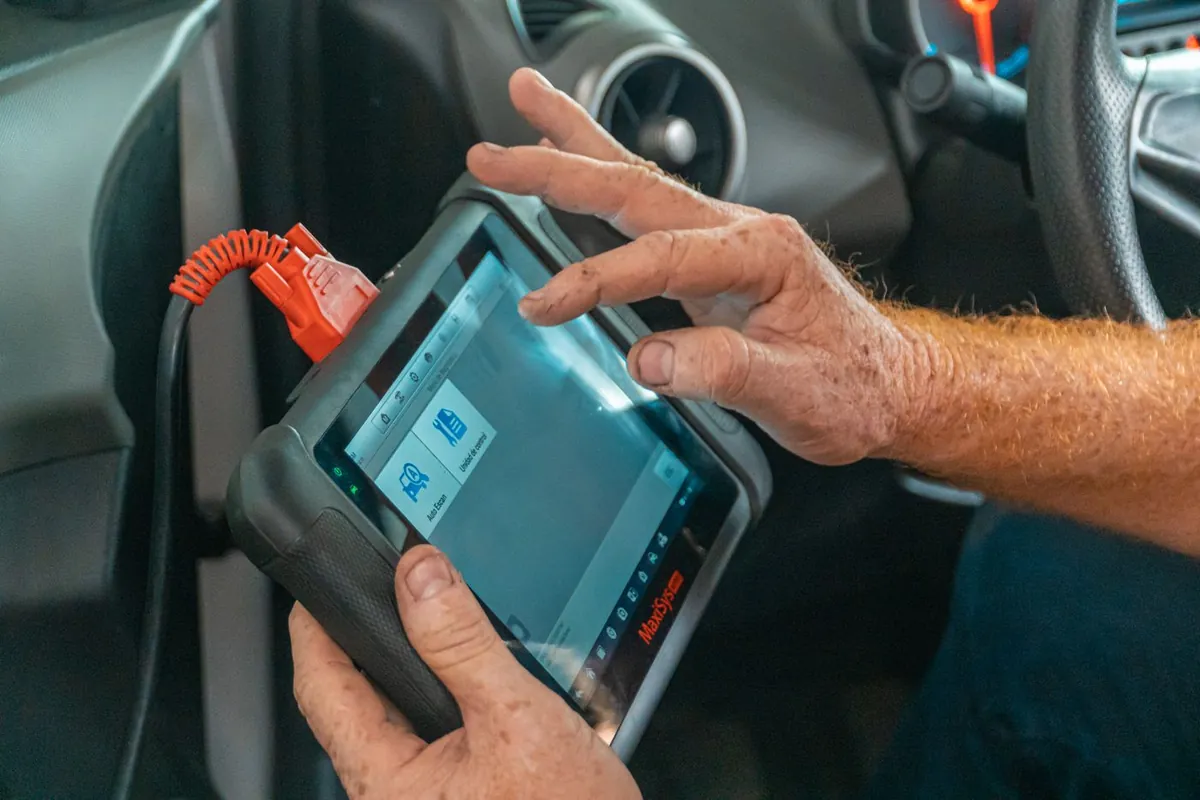
Should a body shop scan my car before and after the repair?
Yes. For most cars built in the last few decades, the vehicle maker's own position is that a car involved in a collision gets a diagnostic scan before the repair and another after it. The first scan finds electronic damage that you cannot see. The second proves that nothing was left broken, unplugged or uncalibrated when the car goes back to you.
Ford, Honda, Nissan, Hyundai and the Stellantis brands (Ram, Jeep, Dodge, Chrysler) say this in their own position statements. GM and Toyota say it in documents summarized by I-CAR, the collision industry's training organization. The details differ, but the direction is the same: scan in, repair, scan out. If an estimate for a real collision has no scan lines on it, ask why.
What does a scan actually find?
A modern car is run by dozens of control modules that talk to each other: air bags, brakes, steering, cameras, radar, lights, doors and more. When one of them sees a fault, it stores a diagnostic trouble code. A scan tool plugs into the car's diagnostic port and reads those codes from every module it can reach.
What makes this matter after a wreck is that a stored code does not always light up the dashboard. According to I-CAR's summary of Toyota's bulletin on the subject, collision damage may not turn on the malfunction indicator lamp, and a capable scan tool is the only way to identify and document trouble codes. Kia's statement makes the same point: a trouble code may not always light an indicator on the dashboard. Ford adds that some faults need several drive cycles before they show up at all.
In plain terms, a scan finds things like:
- Sensor faults from a crash sensor, a radar unit or a parking sensor that took a hit.
- Wiring damage where a harness was pinched, stretched or cut behind a panel.
- Communication faults where a module stopped talking to the rest of the car.
- Restraint system codes that affect whether air bags and belt tensioners will work next time.
Why is a warning-light-free dashboard not proof?
This is the point most drivers miss, so it helps to hear it in the makers' own words. American Honda's 2025 position statement says the presence or absence of dashboard warning lights is not an acceptable method to decide whether post-collision scans are necessary. Hyundai's 2025 statement says it requires the pre-repair and post-repair scan regardless of whether a warning light is illuminated. Kia's statement says scanning should not be considered an option but an essential task, even if the repairs appear minor.
The repair itself can also create faults. Ford's statement notes that removing panels, glass or components can introduce new fault codes that require recalibration or initialization. The Stellantis (FCA) statement lists conditions that could trigger codes, including:
- an accident, even when damage appears minor, with or without air bag deployment;
- a loss of voltage, including a battery disconnect;
- significant disassembly, including bumpers, door handles, headlamps and mirrors;
- interior trim removal or repair;
- glass removal and replacement.
Almost every body repair includes something on that list. That is why the scan after the repair matters as much as the one before it.
What do the makers say, brand by brand?
The table below sums up what each maker's statement, or I-CAR's summary of it, says about scanning after a collision.
| Maker | What it says | Worth knowing |
|---|---|---|
| Ford and Lincoln | Model year 1996 and newer in a collision are required to have pre-repair and post-repair scans. | A collision means damage beyond minor outer-panel cosmetic distortion. |
| Honda and Acura | A preliminary scan during the estimate and a post-repair scan to confirm no codes remain. | Replacing body parts always requires a post-repair scan. The front passenger seat weight sensor check is required after any collision. |
| Chevrolet, GMC, Buick, Cadillac | According to I-CAR, vehicles assessed for collision repair must be pre-scanned during the estimate and post-scanned after repairs. | Many safety components need calibration or learns when replaced. |
| Toyota and Lexus | According to I-CAR, a "Health Check" scan before and after every repair on a collision-damaged vehicle. | Damage may not turn on the warning lamp. |
| Nissan and INFINITI | All 2008 and newer Nissan vehicles require pre- and post-repair scans. | Nissan requires its CONSULT tool and does not validate other scan tools. |
| Ram, Jeep, Dodge, Chrysler | Safety systems must be tested for codes after a collision, using the Mopar wiTECH tool before and after repair. | Even battery disconnects and trim removal can set codes. |
| Hyundai | Requires pre- and post-repair scans regardless of warning lights. | The goal is no codes and all systems calibrated and communicating. |
| Kia | Calls both scans imperative after a collision. | Applies even when repairs look minor. |
Read the table as a starting point, not the last word. Each maker's statement has its own definitions and model years, and the repair information for your exact car is what the shop follows. If your brand is not listed here, ask the shop what your maker publishes. Our repair by make pages and the repair by make guides go brand by brand.
What is the difference between a scan and a calibration?
They are related, but they are not the same job.
- A scan reads. It lists the trouble codes stored in each module and gives a report of what the car knows is wrong.
- A calibration adjusts. It teaches a camera, radar or steering angle sensor where straight ahead is, using targets in the shop, a road drive under set conditions, or both.
The catch is that a camera or radar can be aimed wrong without storing any code. Honda's statement says camera and radar based driver support systems often will not display trouble codes during a scan unless the system is damaged. So a clean post-repair scan does not by itself prove the driver assistance features are aimed correctly. When the maker's procedure calls for a calibration after a part is removed or replaced, that step has to happen whether or not the scan shows a code. Our guide on recalibrating safety cameras and sensors after body repair covers that second step in detail.
How does scanning fit into the repair, step by step?
On a typical collision job the order looks like this:
- Pre-repair scan at the estimate. The report is saved with the file. Codes caused by the collision become part of the repair plan.
- Repair plan and estimate. Damaged sensors, wiring and modules are written up along with the body parts. If a code points to hidden damage, the shop looks for it before the car is torn down further.
- Body, structure and paint work. Parts come off, get repaired or replaced, and go back on.
- Calibrations and initializations. Whatever the maker's procedure calls for after the parts that were touched.
- Post-repair scan. The goal, in Hyundai's words, is systems that are functioning, calibrated and communicating with no trouble codes present.
- Road test and handover. You receive the car with the reports.
If the pre-repair scan finds damage the first estimate missed, the added work is sent to the insurer as a supplement. Our guide to supplements on a repair estimate explains how that works and who pays.
Who pays for scans on an insurance claim?
When the maker calls for scans because of the collision, they are part of the repair and belong on the estimate like any other operation. How your policy treats them is between you and your insurer, so ask your adjuster. The claim belongs to you. The shop's job is to document the damage, write the estimate and work with the adjuster.
If the insurer's estimate leaves the scans off, ask the shop to show the maker's statement for your car and to include it with the estimate. If you are still apart on the amount, read our guide on what to do when the insurance estimate is lower than the shop's. And remember that in Texas you choose where the car is repaired: see choosing your own body shop.
What should I ask, and what should I keep?
Use these questions at the estimate, at any shop:
- Will you scan the car before you write the final repair plan?
- Which tool will you use, and does my maker require a specific one? Nissan, Stellantis and some others name their own tools.
- Will you scan again after the repair, and will I get both reports?
- If codes show up that are not from this accident, will you tell me before doing anything about them? Old faults are your decision, not the claim's.
- Which calibrations does the maker require after the parts you are replacing?
Keep the pre-repair and post-repair scan reports with the final invoice. They are useful if a warning light appears months later, if you sell the car, or if a question about the repair comes up with the insurer. Bring to the estimate your claim number, the adjuster's name and phone number, your registration so the VIN is at hand, and a list of anything odd since the hit: a light that came and went, a feature that stopped working, a seat or mirror that no longer remembers its position.
Hybrids and electric cars have their own extra checks before work starts. If you drive one, see our guide to hybrid and EV collision repair.
How ACE Body & Frame helps
ACE Body & Frame has been on S. Peachtree Road in Balch Springs since 1987, serving Balch Springs, Mesquite and the surrounding area. Our collision repair work sits next to foreign and domestic automotive service and diagnostics, suspension and frame repair, and glass replacement, so the electronic side of a repair is part of the same conversation as the body work.
We write free computerized estimates and accept all insurance claims, and you have the right to choose where your vehicle is repaired. At the estimate, ask us which scans and calibrations your maker calls for on your car and how each will be done. We document what we find and work with your adjuster, while the claim stays yours. Towing and rental car service are available, and repairs are satisfaction guaranteed.
To get started, request a free estimate or call 972-286-0935, Monday to Friday. You can also read about our shop and its history, see what we do on the auto body and collision page, or send us photos and a note about any warning lights before you come in.
Questions people ask next
My car only has a scraped bumper. Does it still need a scan?
It depends on the maker and on what comes off the car. Ford and Honda define a collision as damage beyond minor outer panel cosmetic distortion. Stellantis lists bumper removal and even a battery disconnect as things that can set codes. If the bumper is coming off and there is a sensor behind it, ask what your maker's procedure says.
Can any scan tool do the job?
Not always. Nissan says it requires its own CONSULT tool and does not validate other tools. Stellantis says its wiTECH tool is necessary before and after collision repair. Other makers are less specific. Ask the shop which tool it uses on your make and whether that matches what the maker publishes.
The post-repair scan was clean. Does that mean my lane and braking features work?
Not by itself. Honda's statement says camera and radar systems often will not show trouble codes unless the system is damaged. A sensor can be aimed slightly off and still report no fault. If a camera, radar or the part it mounts to was removed or replaced, ask whether the maker requires a calibration and get the record.
What if the scan finds old codes that have nothing to do with the accident?
A good shop tells you before acting on them. Faults that were there before the collision are usually not part of the insurance claim, so fixing them is your decision and your cost. Ask the shop to mark which codes it believes came from the crash and which look older, and keep the report.
Should I keep the scan reports?
Yes. Keep the pre-repair and post-repair reports with the final invoice. They show what the car reported before and after the work. They help if a warning light appears later, if a question comes up with the insurer, or if you sell the car and a buyer asks how the repair was done.
Ready to get it fixed?
ACE Body & Frame, 2922 S. Peachtree Road, Balch Springs. Free computerized estimates, all insurance claims accepted.
Sources
- American Honda position statement 28870 (2025) Version 6
- Ford Collision Repair Position Statement, "Pre- and Post-Diagnostic Scanning During a Collision Repair Required" (October 1, 2025)
- FCA US LLC Position Statement, "Scan Tool Usage" (December 1, 2025)
- I-CAR RTS, "General Motors Position Statement: Pre- and Post-Repair System Scanning"
- I-CAR RTS, "Toyota/Lexus/Scion Position Statement: Pre- and Post-Repair System Scanning"
- Nissan Collision Position Statement, "Pre- and Post-Repair Scanning, Calibrations" (NPSB/25-946)
- Hyundai Position Statement, "Pre-Repair and Post-Repair System Scanning" (June 3, 2025)
- Kia Pre and Post Diagnostic Scanning Related To Collision Repairs Position Statement (as of June 2018)
- I-CAR RTS, OEM Calibration Requirements Search
Read next
 Repair by make
Buick Enclave and Encore body repair near Balch Springs, TX?
What GM requires when a Buick Enclave, Encore or Envision is repaired, what a full estimate should list, and who pays for what on a Texas claim.
 Repair by make
Lexus RX and ES body repair near Mesquite, TX: what should I ask?
Five questions to ask before a Lexus RX or ES body repair near Mesquite: the Health Check scan, no heat on structure, glass, camera calibration and paint.
 Repair by make
Volkswagen Jetta and Tiguan collision repair east of Dallas?
What Volkswagen says about scans, structural parts, airbags and wheels, and what to ask a body shop about your Jetta, Tiguan, Passat or Atlas near Dallas.
More: all repair by make guides, collision repair, repair by make, reviews and directions to the shop.