
In short
Most RV fiberglass damage can be repaired: cracks, holes and broken corners on molded caps and skirts are rebuilt with new fiberglass and resin and refinished to match. Replacement makes more sense when a sidewall skin has separated over a large area, the part is shattered, or wet or rotted material sits behind it.
- Molded caps and skirts are usually repairable.
- Laminated sidewalls depend on whether the skin is still bonded and dry.
- Bubbles or waves in a sidewall point to delamination, often from a leak.
- Fix the leak before the wall, or the repair will fail again.
- Trailers usually need an RV policy to cover damage to the trailer itself.
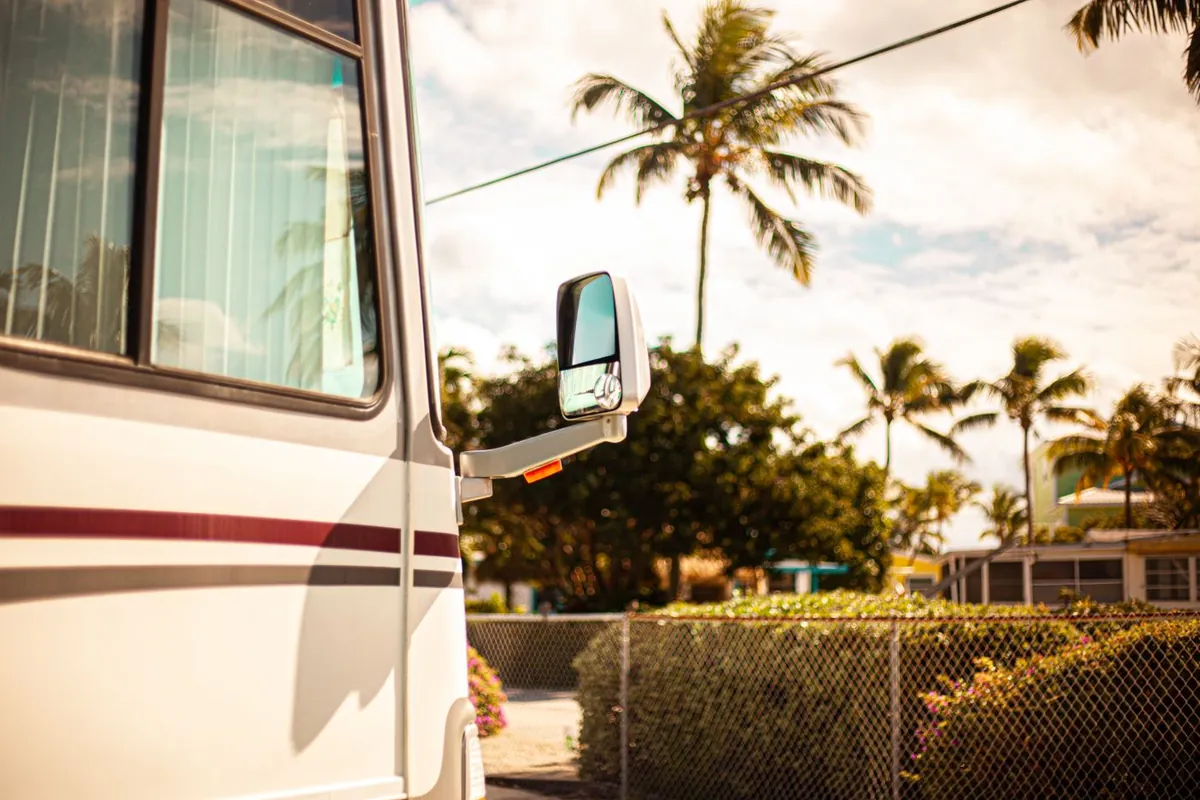
Can RV fiberglass damage be repaired, or does the panel have to be replaced?
Most RV fiberglass damage can be repaired. Cracks, holes, gouges, broken corners and impact damage on molded front and rear caps, fenders, skirts and compartment areas are routinely rebuilt with new fiberglass and resin, shaped, and finished to match. A repaired fiberglass part, done properly, is as strong as the original and does not show.
Replacement becomes the better answer in a few situations: a flat sidewall skin that has separated from the wall behind it over a large area, damage so widespread that a repair would cover most of the part, a cap that is shattered into pieces, or a part the coach builder still sells new at a point where repair work would take longer than fitting it. Even then, replacement is not always simple, because large RV panels are often made for one model and year.
The deciding factor is usually not the crack you can see. It is whether the layers behind the fiberglass are still bonded and dry. That is why a proper inspection comes before anyone tells you repair or replace.
What kind of fiberglass is on my RV?
RVs use fiberglass in two quite different ways, and the repair is different for each.
- Molded parts. Front and rear caps, wheel well skirts, some roofs, and many trim pieces are molded fiberglass shapes with a smooth colored or painted outer layer called gelcoat. These are thick, shaped parts and are the most repairable.
- Laminated sidewalls. Many motor homes, travel trailers and fifth wheels have sidewalls made of a thin fiberglass skin glued to a backing board, with insulation and a frame of aluminum or wood behind it. The skin is strong only as long as it stays bonded to what is behind it.
- Corrugated or smooth aluminum walls. Some RVs have aluminum siding rather than fiberglass on the sides, with fiberglass only on the caps. Those sides are repaired as metal.
If you do not know which you have, the coach builder's model information or a quick look inside a compartment door at the wall edge will usually tell a technician. Our guide on motor home body repair near Dallas explains how the coach and chassis are built and repaired.
Which fiberglass damage is usually repaired, and which replaced?
The table below matches common fiberglass damage to the usual choice and the reason behind it.
| Damage | Usual choice | Why |
|---|---|---|
| Spider cracks in gelcoat, no soft spots | Repair the gelcoat and refinish | The fiberglass underneath is sound; only the surface layer cracked |
| Crack or hole in a molded cap | Repair with new fiberglass from behind and in front | Molded parts rebuild well and new caps can be hard to source |
| Corner of a cap broken off | Rebuild the corner, or replace if the cap is in many pieces | A clean break can be rebuilt; a shattered cap may not be worth it |
| Small puncture in a laminated sidewall | Repair the skin and check the layer behind it | Small areas can be patched if the wall is dry and bonded |
| Bubbles or a wavy area in a sidewall | Inspect for delamination; re-bond or replace the skin | The skin has let go of the wall; the cause, often water, must be fixed |
| Long scrape along a sidewall | Repair the skin, refinish, replace graphics | Shallow scrapes do not reach the wall structure |
| Wall pushed in with a bent frame behind | Open the wall, repair the frame, then repair or replace the skin | The structure behind has to be straight before the outside can be right |
Read down to the closest match. If your damage fits two rows, the lower row is the safer assumption until the wall behind has been checked.
Until the repair, keep water out. Clean and dry the area, then cover any crack or hole with a weatherproof tape made for RVs or a tarp secured so it cannot flap against the finish. Park with the damaged side away from prevailing rain if you can, and check inside after each storm for damp spots. Take clear photos of the damage before you cover it, both close up and from a distance, so the adjuster and the shop can see exactly what happened. A small crack that stays dry is a simple repair; the same crack after a wet season can mean opening the wall.
How is a fiberglass repair done?
A sound fiberglass repair follows a set order, and each step matters to how long it lasts.
- Assess. The area is tapped and pressed to find loose or soft spots, and the inside is checked where it can be reached.
- Remove damaged material. Cracked and loose fiberglass is ground away until only solid material remains. A crack that is only filled on top will come back.
- Taper the edges. The edges around the damage are ground to a gentle slope so new layers overlap a wide area of good fiberglass.
- Lay up new fiberglass. Layers of glass cloth or mat are set in resin, from behind where possible and from the front, building back the original thickness.
- Shape the surface. After curing, the area is sanded and filled to match the original contour.
- Finish. Gelcoat or primer and paint go on, followed by color matching and blending, and new decals or graphics where needed.
- Reseal. Any trim, lights, vents or windows removed for the work are reinstalled and sealed.
Resin and gelcoat need time to cure, and weather affects that. Rushing a fiberglass repair is how it ends up cracking again.
What is delamination, and why does it change the answer?
Delamination is when the fiberglass skin of a laminated wall separates from the board or foam behind it. It shows as bubbles, waves or a soft, drummy feel when you press the wall. Impacts can cause it, but water is the usual culprit: a leaking seam, window, light or roof edge lets moisture into the wall, the glue lets go, and wood behind it can soften or rot.
A small delaminated area can sometimes be re-bonded by injecting adhesive and clamping the skin back. A large one, or one with wet or rotted material behind it, usually means taking the skin off, replacing the damaged backing or framing, and fitting a new skin. On some walls the whole sidewall skin is replaced as one piece.
Whatever the repair, the leak that caused it has to be found and fixed first. Otherwise the new work fails the same way. Our RV body checklist before a trip lists the seals worth inspecting a few times a year, and our guide to RV windshield, awning and door repair covers openings that often leak after a hit.
Will the repaired area match the rest of the RV?
It can, with care. Older gelcoat chalks and yellows in sun, and many RVs have painted swirl schemes and large printed decals rather than one solid color. A good match usually means testing the color against the aged surface, blending into the surrounding area, and replacing graphics in full sections rather than patching them.
Ask whether the coach builder still sells your decal set; if not, a shop can often have matching graphics made from photos and measurements. Our guide on whether new paint will match explains blending, which works the same way on an RV as on a car.
Is RV fiberglass damage covered by insurance in Texas?
It depends on the type of RV and your coverage. The Texas Department of Insurance (TDI) explains:
- Travel trailers and fifth wheels: your auto policy might pay for accidents you cause while towing, but you probably need a separate RV policy or endorsement to cover damage to the trailer itself.
- Motorhomes: Texas law requires an auto policy with liability coverage, and you need collision and comprehensive coverage to pay for damage to your own motorhome.
- Hail, fire, flood, vandalism and theft fall under comprehensive coverage, according to TDI's auto insurance guide.
- Belongings inside need an RV policy, because a home policy's coverage for them is very limited.
The Texas Consumer Bill of Rights for personal auto insurance also says you choose the repair shop and parts, and the insurer is not required to pay more than a reasonable amount. See how RV insurance claims work in Texas and, for towables hit while parked, travel trailer and fifth wheel repair. If a storm caused the damage, our hail damage and insurance guide explains the claim steps.
How ACE Body & Frame helps
ACE Body & Frame has been on S. Peachtree Road in Balch Springs since 1987, serving RV owners in Balch Springs, Mesquite and the surrounding area. Fiberglass repair and motor home and RV repair are among our services, along with welding, fabrication, glass replacement and upholstery.
- A free computerized estimate that says whether we would repair or replace each damaged part, and why, after checking for soft spots and delamination. Request a free estimate with photos and your RV's make, model and year.
- All insurance claims accepted. We document the damage, write the estimate and work with the adjuster. You have the right to choose where your vehicle is repaired.
- Towing available, and repairs are satisfaction guaranteed.
What to bring: the RV, your claim number if you filed, photos taken right after the damage, and any decal or paint scheme names you know. Call 972-286-0935, Monday to Friday, or send your RV details online. You can read what our customers say, browse all RV and motor home guides, or see the full list of work on our RV repair service page.
Questions people ask next
Can I fix a small fiberglass crack myself?
A hairline crack in gelcoat can be sealed with a gelcoat repair kit to keep water out until it is properly repaired. A crack that goes through the fiberglass, or one near a seam, window or corner, needs the damaged material ground out and new layers built up. Surface filler alone tends to crack again.
How do I check for delamination?
Look along the sidewall in low, angled light for bubbles or waves, and press gently on the wall. A soft, spongy or hollow-sounding area suggests the skin has separated from the backing behind it. Check most carefully below windows, around lights and near the roof edge, where leaks usually start.
Can a new front cap still be bought for an older RV?
Sometimes, but many caps are made for one model and year, and some are no longer produced. That is one reason molded caps are so often repaired. A shop should check availability with the coach builder before recommending replacement, and tell you how long sourcing is likely to take.
Will a fiberglass repair show through the paint or graphics?
Not if the edges are tapered, the surface is shaped correctly and the color is tested and blended against the aged finish. Graphics are usually replaced in full sections rather than patched. Ask how the shop will match your swirl scheme or decals before work begins.
Does my auto policy cover damage to my travel trailer?
Often not by itself. TDI says your auto policy might pay for accidents you cause while towing a travel trailer or fifth wheel, but you probably need a separate RV policy or endorsement to cover damage to the trailer. Check your policy or ask your agent what applies to your trailer.
Ready to get it fixed?
ACE Body & Frame, 2922 S. Peachtree Road, Balch Springs. Free computerized estimates, all insurance claims accepted.
Sources
- TDI, "Insurance for RVs: Know your coverages"
- TDI, Automobile insurance guide (cb020)
- Consumer Bill of Rights, Personal Automobile Insurance (28 TAC 5.9970(b), 2026 Version)
Read next
 RV and motor home
RV upholstery and interior repair near Dallas: what can be fixed?
Torn seats, flat cushions, sagging panels and stains can usually be fixed. Learn when it is fabric only, when it is a leak, and what to ask an RV shop.
 RV and motor home
Travel trailer or fifth wheel hit in a parking lot: who fixes it near Mesquite?
Trailer or fifth wheel hit while parked? What to photograph, when not to tow it, whose insurance pays in Texas and what a body shop near Mesquite repairs.
 RV and motor home
What should I check on my RV body before a long trip from the Dallas area?
Roof seals, caps, walls, windows, awning, lights, frame and hitch: a pre-trip RV body checklist for Dallas-area owners, with what must be fixed first.
More: all rv and motor home guides, rv & motor home, repair by make, reviews and directions to the shop.